The quality of public spending is crucial, and further increases in the size of the Fijian government should be avoided. Untargeted subsidies or price caps would be very expensive for the government and would provide less help to the most vulnerable.
That is the statement by the International Monetary Fund team led by Alasdair Scott that held discussions with the Fijian authorities and other stakeholders in Fiji over the last two weeks.
Scott says Fiji's national budget passed last year leaves the government with very little room to handle unexpected needs for extra spending.
He says while the economy now faces higher fuel prices, in the future it could also face natural disasters or new global shocks.
Scott says the challenge for fiscal policy is therefore to rebuild fiscal buffers with growth-friendly reductions in deficits, while managing higher costs of living.
The IMF team suggests this could be facilitated by a reform package of revenue mobilization—building on excellent progress on compliance by the Fijian Revenue and Customs Service, but also including restoring the VAT rate to its previous rate of 15 percent — and expenditure rationalization.
Scott says to support those most vulnerable to fuel price increases, targeted social assistance is the best option.
He says the needed fiscal adjustment could be made growth-friendly by increasing public spending on development and infrastructure.
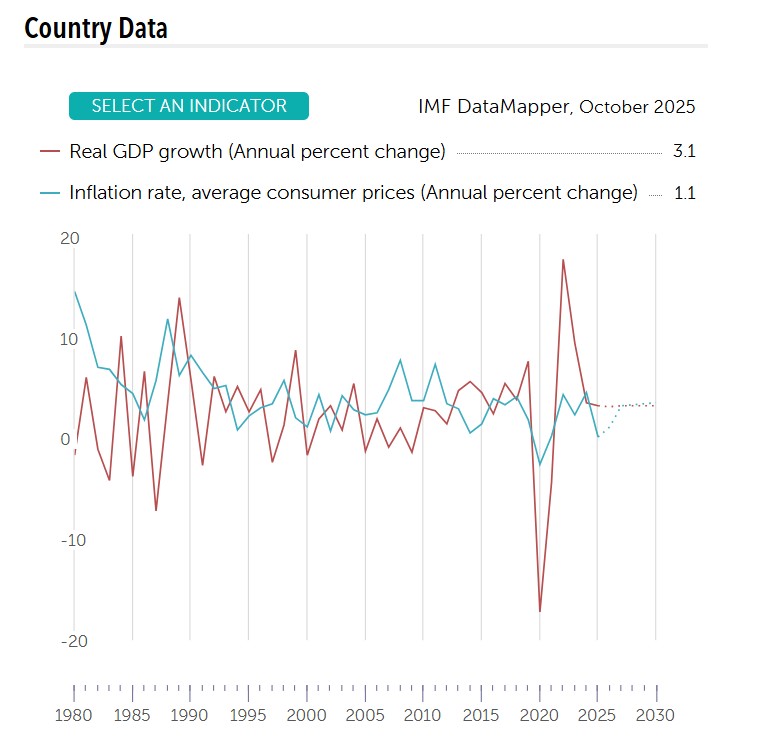
The IMF team also says with the Fijian economy facing new headwinds, growth is projected to moderate to around 2½ percent in 2026, while average inflation for the year is expected to increase to over 2 percent.
The main policy challenge is to rebuild fiscal buffers, so as to provide room to cope with future macroeconomic shocks, while also increasing much-needed capital spending.
The team suggests that social assistance measures targeting the most vulnerable would be the best response to fuel price pressures.
Other priorities include improving the monetary policy framework and advancing structural reforms to raise potential growth rates.
Scott says economic activity remained resilient in 2025, supported by strong tourism inflows, continued remittances, and fiscal stimulus.
He says this momentum has begun to ease into early 2026.
The IMF team says tourism already appeared to be softer for the first part of this year, and now higher global oil prices are weighing on the outlook.
Scott says risks to the outlook are to the downside.
He says they arise primarily from fiscal financing pressures, which could raise borrowing costs, constrain spending, and increase pressures on external balances and reserves.
Global fuel prices could increase by more than assumed in these projections, passing through to still-higher inflation and a weaker external position.
Tighter global financial conditions could also increase the cost of external financing.
The IMF team stresses that policies need to address both near term and medium-term challenges.
They say structural reforms are needed to support medium-term growth and resilience.
Scott says the Fijian authorities’ strategy, as set out in the National Development Plan 2025–29 and Vision 2050, appropriately focuses on raising productivity, strengthening human capital, and scaling up investment to support the transition to high-income status.
However, the IMF team says implementation has lagged.
It says achieving stronger and more durable growth will require clearer prioritization and sequencing of reforms, improved implementation capacity, and sustained efforts to mobilize public and private investment, particularly in climate-resilient infrastructure.
They add the exchange rate peg maintained by the Reserve Bank of Fiji continues to serve the economy well.
The team says the effectiveness of the monetary policy could be improved by strengthening the links from the policy interest rate to retail rates.
This would require a gradual normalization of liquidity conditions and interest rates.